
A Strategic Perspective for Asset-Intensive Industries
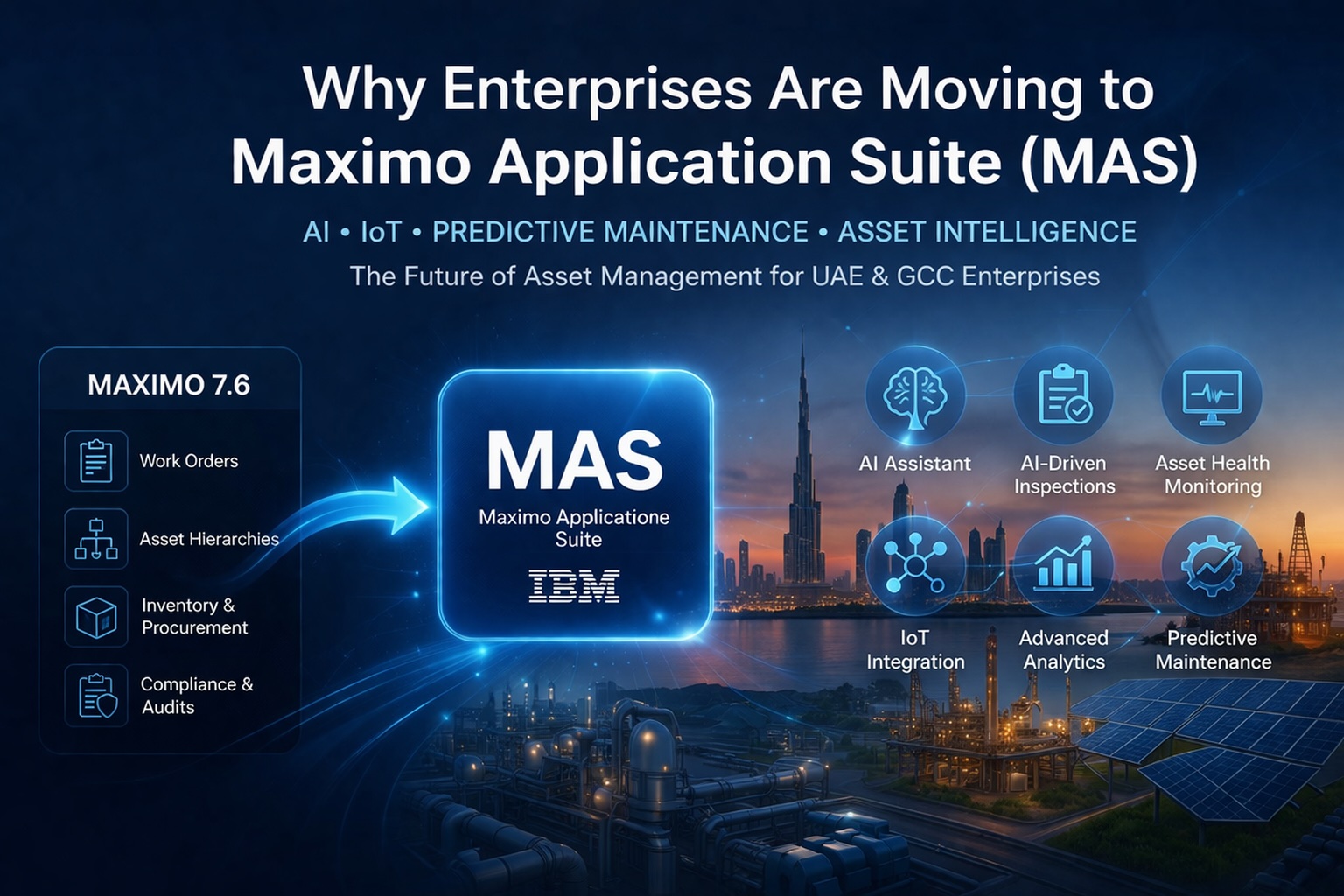
For over a decade, IBM Maximo 7.6 has been the backbone of enterprise asset management across industries such as Oil & Gas, Utilities, Transportation, and Infrastructure in the UAE and wider GCC.
It has enabled organizations to manage:
- Work orders and maintenance execution
- Asset hierarchies and lifecycle tracking
- Procurement and inventory integration
- Regulatory compliance and audit readiness
However, the expectations from asset management platforms have fundamentally changed.
Today’s enterprises require:
- Real-time operational visibility
- Predictive maintenance capabilities
- Integration with IoT and industrial systems
- AI-driven decision support
This is where IBM Maximo Application Suite (MAS) comes in.
What Is Driving the Shift from Maximo 7.6 to MAS?
The move to MAS is not simply a technological upgrade — it is driven by a shift in how organizations approach asset performance and reliability.
MAS introduces a modern, intelligent platform built to support:
- Data-driven maintenance strategies
- Predictive and prescriptive analytics
- Integrated asset intelligence across systems
- Scalable, cloud-ready architecture
Built on Red Hat OpenShift, MAS allows deployment across:
- On-premises environments
- Private cloud
- Public cloud
- Hybrid architecture
For organizations in the GCC pursuing digital transformation initiatives, MAS becomes a central platform connecting operational data, maintenance intelligence, and enterprise systems.
Before making this transition, many enterprises begin with a structured evaluation through Enterprise Application Services to assess infrastructure readiness and migration complexity.
Key Day-One Benefits of Maximo Application Suite (MAS)
One of the biggest advantages of MAS is that it delivers immediate value through advanced capabilities available from day one.
- AI Assistant for Faster Decision-Making
MAS introduces AI-powered assistants that enable:
- Faster access to asset history
- Intelligent troubleshooting recommendations
- Improved technician productivity
This reduces dependency on manual expertise and accelerates issue resolution.
- AI-Driven Inspection Workflows
Inspection processes become more intelligent with:
- Automated anomaly detection
- Risk identification during inspections
- Standardized inspection execution
Organizations can further strengthen inspection discipline through IBM MAS Inspections Application or use our Digital Operations Management System (DOMS) to improve data quality feeding into MAS.
- Real-Time Asset Health Monitoring
MAS provides continuous visibility into asset condition using:
- Operational data
- Maintenance history
- Performance trends
This enables maintenance teams to prioritize work based on asset condition rather than static schedules.
- IoT and Industrial Data Integration
MAS integrates with:
- IoT sensors
- SCADA systems
- Industrial control systems
This allows real-time data to trigger:
- Alerts
- Work orders
- Condition-based maintenance
For organizations managing complex contractor ecosystems, integrating workforce governance through Contractor Personnel Management System ensures operational alignment with these automated processes.
- Advanced Analytics and Reporting
MAS includes powerful analytics capabilities that enable:
- Maintenance performance tracking
- Asset failure analysis
- Operational trend visualization
This supports better decision-making at both operational and executive levels.
- Predictive Maintenance and Asset Intelligence
Predictive maintenance is one of the most transformative capabilities of MAS.
By analyzing historical and real-time data, MAS can:
- Predict failures before they occur
- Optimize maintenance schedules
- Reduce unplanned downtime
- Extend asset lifecycle
However, predictive success depends on structured data and governance — not just technology.
Why Staying on Maximo 7.6 Is Becoming a Strategic Risk
While Maximo 7.6 continues to operate effectively, organizations that delay modernization may face:
- Increasing infrastructure limitations
- Limited access to advanced AI capabilities
- Higher long-term maintenance costs
- Integration challenges with modern platforms
- Reduced competitive advantage
Enterprises that begin planning early retain greater control over cost, risk, and transformation timelines.
Key Challenges in MAS Migration
Migration to MAS requires careful planning across multiple dimensions:
- Infrastructure readiness (OpenShift, containers)
- Licensing transition (AppPoints model)
- Integration validation (ERP, SCADA, GIS)
- Data migration and cleansing
- Change management and training
A structured and phased approach is critical to minimizing disruption.
Best Practices for a Successful MAS Migration
Leading GCC organizations adopt the following approach:
- Conduct infrastructure readiness assessment
- Align AppPoints licensing with business strategy
- Perform full integration regression testing
- Strengthen data quality and inspection workflows
- Execute phased rollout strategy
- Enable workforce through mobility solutions
Where workforce enablement is critical, organizations often align transformation with Enterprise Mobility Solutions to ensure adoption across field teams.
Executive Takeaway
The move from Maximo 7.6 to MAS represents a shift from:
Reactive maintenance → Predictive asset intelligence
Organizations that approach this transition strategically can:
- Improve asset reliability
- Reduce operational costs
- Enhance decision-making
- Enable long-term digital transformation
MAS is not just a platform upgrade — it is a foundation for intelligent asset management.
